Tuesday, February 9, 2021

Now is always now


Time to begin again writing adding blogposts. During the pandemic I've been dormant, hibernating like some old bear up in the mountains. Well, that's not quite true. I've been doing a lot of journal writing and trying to wrestle poems and ideas from the journals. Still, it's time to begin again with the practice of Zen blogs and Zen writing. Bear with me. And forgive me for a silly pun.

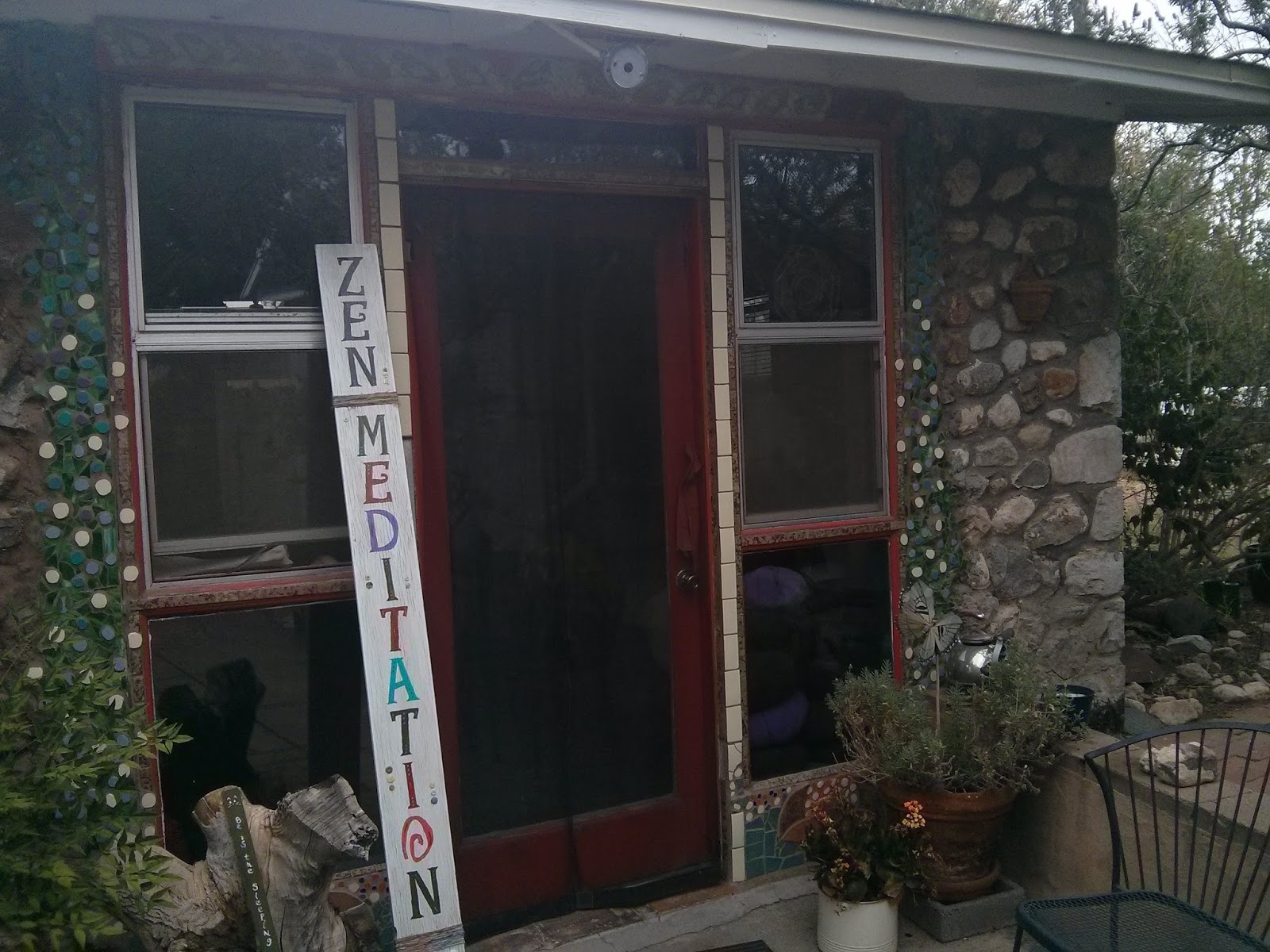
I thought a good place to start is with a wonderful poem by my friend J.B. Bryan, a cantankerous Zentista who lives in Albuquerque. He's a poet, painter and a "collagist." Is there such a word? He's always putting together random pieces of things into stews, art pieces, music and his life. For instance, in the photograph above J.B. had just served me tea in the adobe teahouse he had built in his studio in Placitas. He had studied the traditions and created his own ceremony, based on the traditions, but with his own utensils and what seemed appropriate for his practice. 

PRACTICE

a body such as this body
tosses back its antlers &
spins them like a propeller

skull finally work
iris, planet, sun
I won’t spend a dime

Great Faith
Great Doubt
Great Effort

O the universe has a wit
easily tasted in green leaves
boiled with water

what’s the bloodstream?
but a river of huge loves &
thunderous flowers of combustion!

be sure to practice everyday

––JB Bryan 


Remember: On Sunday mornings 10AM Mountain Time, we are having Zoom services (brief chanting, a 40 minute period of zazen, and a dharma talk). We also have a lively Wednesday evening book club at 6PM. Write me at bbyrd@cincopuntos.com for the appropriate links. 

Be well. Sit strong. Practice wisdom and compassion. If you miss the mark, oh well, remember now is always now. 

Bobby Kankin Byrd
Guiding Teacher


Thursday, December 17, 2020

Nothing to Give, No One to Receive It


Excerpt: Nothing to Give, No One to Receive It - Norman Fischer


Some gifts we see as gifts (the birthday or holiday gift) and others we usually don’t see as gifts (the gift of sunlight, the gift of breath). The practice of giving extends to all forms of giving.

Traditionally, there are three things to give: material gifts, the gift of dharma, and the gift of freedom. But really there are many more things to give: the gift of listening, the gift of love, the gift of creation, attention, and effort. To make a poem or a painting is to practice giving, as is cooking a meal, cleaning a room, putting a single flower in a vase. In his fascicle “Four Methods of Guidance for Bodhisattvas,” Dogen writes that to launch a boat, build a bridge, and earn a living are acts of giving. To be willing to be born—and to die—is to practice giving.

I usually think of four simple ways to practice giving: giving yourself to yourself (that is, to be generous in your attitude toward yourself); giving materially to others (giving money or other material gifts to those in need and to those not in need); giving fully and without reservation the gift of your presence and respect; and giving yourself completely in your meditation practice.

There are six paramitas or perfections that define the Mahayana path: giving, ethical conduct, energy, patience, meditation, and wisdom. It is no wonder that giving is the first of these. The more you study it, the more it seems that giving is the whole of the Buddha way.

Many thanks to Polly Shikan Perez for this blog post!

Wednesday, January 22, 2020

Notes from my hand-written Journal.


“Out of nowhere  heart-mind comes forth.”
―Diamond Sutra

My morning ritual is to stumble out back to the zendo and turn on the electric heaters. I want to feel the day. I want my meditation spot to get warm while I drink my coffee. And I want my bowels to move. I also want to hear birdsong, the chatter of the universe, so I pour birdfeed into the feeder and check the bird water.

Yesterday was a day of clouds and cold winter rain. It’s easy for us desert people to get bone-chilled and sad on days like that. Sure, we know better. Our rational minds remind us how good the rain is for the desert, but deep down there’s a hunger for warmth and sunshine. Radiant heat! Three or four cold days of clouds and rain and desert folk start talking some serious sorrow.

This morning when I got up I was half-expecting more rain. Drowsy and still warm from a night under the covers, I put on my robe and crocs and went out the back door― the new day absolutely startled me. Golden sunlight lit up the rooftops and made Franklin Mountain beyond glow. The white-winged doves, perched high up on the electric wires where the sunshine is the best, began to coo and flap their wings. They were ready with their winter hunger. Likewise the house sparrows and finches (some juncos too) sat quietly hidden in the bushes, watching and waiting. I peed on the leafless desert willow. It too was waiting. I went back inside. Behind me the birds began to celebrate the feast.


Post Script. I've neglected writing on this blog for so long. New Year Resolution! Write more Zen Stuff! Ha! Wonder how long that will last. Perhaps some of our fellow Sanghistas will join me. 

Wednesday, October 9, 2019

Generosity!

MARCH 2018: SEVERAL OF OUR SANGHA MEMBERS
MOVING A BUDDHA STATUE AND OTHER  ZEN PARAPHERNALIA
FROM THE STONE GARAGE ON LOUISVILLE AVENUE
TO THE ZEN HOUSE AT 2718 CAMPBELL
Generosity, or "Dana", is the first of Gotama's Six Perfections. Gotama is that guy who has come to be known as the Buddha. Everyday, along with his fellow monks, he'd get up, sit zazen, then grab his begging bowl and go from home to home to beg for food. He believed deeply in reciprocity, engaging in the life of his community, receiving and giving, breathing in and breathing out.

So "The Zen House" at 2718 Campbell, otherwise known as Both Sides / No Sides Zen Center of El Paso, is asking for your help in continuing the practice and celebration of the Dharma in El Paso. The Zen House is funded entirely by the donations of our members and our friends. Our basic expenses are approximately $1,100 a month. This includes rent, electricity, gas and water. Anything you can give is very much appreciated.
  • Folks can help support El Paso's Zen Community: 
  • by giving via our PayPal account at bothsidesnosides@gmail.com;  
  • by sending along a check to the Zen House at 2718 Campbell, El Paso, TX 79902; 
  • or, best yet, come by the Zen House and drop your donation in the Dana Bowl, staying to sit zazen with us, share tea and conversation.   
We have our services on Sundays, 10 AM, and a "Just Sitting" silent practice on Wednesday nights, 6 to 7 PM. Good things are happening in the silence of zazen and in our daily practice. Come by and join us.

For more information, you can call me at 915-241-3140, write me at the email address, message us via Facebook or comment on this blogpost.

A deep bow to you all, plus a little Texas Two-Step, some flowers and songs.

Bobby Kankin Byrd, Sensei

Tuesday, March 20, 2018

Three Poems: Rumi, Neruda, Li Po


I drafted this post, oh, in November I think but never finished it. Diana DoShin Johnson used these three poems in a dharma talk on one of her returns to El Paso / Las Cruces. We have them on hand. The poems have not grown older. I have. Bobby Kankin


Story Water  
                     ―Rumi

A story is like water
that you heat for your bath.

It carries messages between the fire
and your skin. It lets them meet,
and it cleans you!

Very few can sit down
in the middle of the fire itself
like a salamander or Abraham.
We need intermediaries.

A feeling of fullness comes,
but usually it takes some bread
to bring it.

Beauty surrounds us,
but usually we need to be walking
in a garden to know it.

The body itself is a screen
to shield and partially reveal
the light that’s blazing
inside your presence.

Water, stories, the body,
all things we do, are mediums
that hide and show what’s hidden.

Study them,
and enjoy this being washed
with a secret we sometimes know,
and then not.


XV 
               ―Pablo Neruda

Nosotros, los perecederos, tocamos los metales,
el viento, las orillas del océano, las piedras,
sabiendo que seguirán, inmóviles o ardientes,
y yo fui descubriendo, nombrando todas las cosas:
Fue mi destino amar y despedirme.

We, the mortal ones, touch metal,
the wind, ocean shores, stones,
knowing they will go on, inert or burning,
and I went discovering, naming all these things:
It was my destiny to love and say goodbye.

In Memory of Apollinaire “Polo” Valenzuela


The Birds Have Vanished
               ―Li Po

The birds have vanished into the sky,
and now the last cloud drains away.

We sit together, the mountain and me,
until only the mountain remains.

(Translation by Sam Hamill)

Thursday, February 16, 2017

Good luck with that, huh?`

Both Sides / No Sides Zendo
Summer Morning after an Unexpected Rain
Beings are numberless, we vow to save them.    
A Journal Note

(Egad, I wrote the in June 2015, a year and a half ago. I forgot to push the publish button. Oh, well. Better now than never. Things have changed, of course. Polly lives in Las Cruces with her partner Steve, I talk to her and see her from time to time, but we all miss her. I don't see Matthew anymore. I miss seeing him. He's a good guy. I hope he walks through the door again sometime soon. Meanwhile, I hope you enjoy the post.)

One Tuesday night when I was out of town, Matthew Torres—the young man with the curly hair who comes when he can—brought the Zendo a gift, a little paper dolphin he had made, origami style, from thick paper marbled with many pastel colors. I was out of town and my fellow priest Polly Perez was in charge. Knowing Polly, she received the dolphin with a joyful smile. She placed it in the arms of the bronze teaching Buddha who sits on the altar. But then it was time to ring the bell. She lit the oil lamps and the incense, and the services began, as always, with the voices of those gathered together to sit zazen, atoning for the harm we cause in the world.

So this morning, back in town—the smell of dampness in the air from the little bit of rain we had last night—I went out to the zendo. Lucky me, the zendo is in my backyard. The little building is a 90 year old stone garage that Lee and I, with a little bit of extra cash, transformed 25 years ago into my office. Now it’s the Both Sides / No Sides Zendo, a 12-seater. Buddhism does things like that, letting one thing become another. I bowed to the bronze Buddha. He still carries the dolphin in his arms. This makes me happy. I lit the lamps and a stick of incense. I too recited the Prayer of Atonement for the harm I cause in the world. I bowed to my zafu and began chanting in preparation to sit zazen. Ernie the black cat walked in. He strolled up to me for a scratch behind the ears, and then he slowly went from zabuton to zabuton, sniffing at the wonderful places full of human smell to lay his body down. He chose, finally, the zabutons stacked beneath the altar. He climbed inside the little cave and immediately went to sleep, so black you cannot tell cat from zafu until he opens his golden eyes.

Stephen Batchelor, toward the end of his book Confessions of a Buddhist Atheist, says Gautama contributed four basic elements to the Dharma, elements that were not derived from the Indian culture of his time.

  1. The principle of “this conditionality, conditioned arising.”
  2. The process of the Four Noble Truths.
  3. The practice of mindful awareness.
  4. The power of self-reliance.
So there we were—the Buddha, the paper dolphin, the black cat and the old man sitting zazen. We felt the breeze seeping into the stone zendo, and we listened to the mockingbirds and the mourning doves. By sitting zazen, Dogen says, we express our true nature. Ideas and words are irrelevant. Just pieces of trash floating past. But the bell does ring, sooner or later. Like always, I recited the Four Great Vows, vowing to save the numberless earth beings, ending all delusions, entering all the boundless Dharma gates, and becoming one with the Buddha’s Way.

Good luck with that, huh? But that’s what we vow. Over the years, the roots of these vows, watered by the daily practice of zazen, grow deeper into our heart-mind. I blew out the lamps, bowed to the Buddha and the dolphin in his arms, scooted Ernie out of the zendo, and went about my life. As one more of the numberless beings, I carried along the little bit of freedom I realized within those old stone walls—the morning light, the open door, the fresh but damp spring breeze and the happily dissonant songs of mockingbirds and mourning doves.

Bobby Kankin Byrd 
June 2015

Ernie, the Dolphin & the Buddha
A lousy photo but you get the picture!

Ernie opens his eyes!


Saturday, February 11, 2017

Old Man Winter Morning Zendo Poem


Old Man Winter Morning Zendo Poem


Morning zazen makes no sense at all, 
Absolutely no sense at all.
But I’m happy to be here, after practice,
Alive on my black cushion, bundled up
From a nagging sickness, sipping cold coffee,
Incense burned to ashes in the quiet,
Candles flickering, sunlight shadows
On the brown wall, and those silly pigeons,
They’re eating out of the cat dish again.
Ha! Good for them.
They don’t know right from wrong.
What better time to give thanks,
Thank you, thank you
A single grackle screeches out
Her love for me
And then she flies away.


In celebration of Harvey Daiho Hilbert Roshi's 70th Birthday


Each moment, life as it is, the only teacher. 
Being just this moment, compassion’s way.  
―The Third and Fourth Principles of Practice as adapted by Charlotte Joko Beck and the Ordinary Mind School from the Buddha’s Four Noble Truths
You know, when you first start reading about Zen practice, you come across two visions of how to sit on a cushion, Rinzai Zen and Soto Zen. These are the two primary Japanese lineages. Each is pigeonholed into its own stereotype. Rinzai is the sterner practice, more martial in observance of all the rules, and Soto Zen is softer and more lenient in many ways. In Rinzai Zen, you sit zazen facing the sangha, you have regular sansen (interview with the teacher), the teacher gives you koans to break the hard walls of psyche, and the aim is to experience “kensho,” or sudden enlightenment. In Soto Zen, you sit facing the wall, you have irregular dokusan (interview with the teacher), and there is no aim, per se. You sit shikantaza, which means “just sitting.” The Soto lineage favors of what is called “gradual enlightenment.” Of course, in actual practice, especially here in the United States, the differences between the two lineages have faded away in some aspects, and really, the only way to find out the real differences, is to go sit with one group or another. If it’s true Zen practice, the foundation will always be zazen, sitting on a cushion (or chair, as your body requires), back straight, eyes open, breathing in and out, bringing the mind to the point of existence. 
Ha! The reason I wrote all of that is because of that little poem up above, “Old Man Winter Morning Zendo Poem.” I consider it a “Zen poem” because it speaks of my daily practice. But in high school and college, when I started reading about Zen poets and artists, I was always intrigued by how they had these sudden blasts of simultaneous insight and expression. Basho and his buddies would sit at the edge of a creek, getting drunk on sake and throwing down haiku and renga at each other in raucous laughter-filled dharma battles. The great calligraphers would approach a blank scroll with brush and ink, there would be a frenzied dervish swirling of arms, perhaps a shout and grunts, then, ZAP! And there it was! Another masterpiece!
Oh, I wanted to be like them. That was my romantic notion. Now I’m almost 75, and I want to say my Zen and writing of poetry is not like that at all. That’s not who I am. That’s not how I write poems. 
Every day I try to write in my journals. Mostly with my illegible (except to me) hand-writing. Sometimes on the computer. Sometimes even on my cell phone, talking, not writing, into the damn thing if I have idea, see or hear something that interests me. Anyway, from time to time I go through my journals and try to harvest poems. When I find something, I fiddle with it some, and, after a while, if I like it, I move it to my “poems in-progress” files.
Several weeks ago, I scribbled in my notebook about the silly pigeons eating out of the cat dish. When I finish my morning zazen, I can see them out there, finishing up what the cats didn’t eat. That irritates Lee and me, them eating the cat food and shitting all over the place. We wish the cats would do their job and harvest the pigeons but the cats don’t care about the pigeons. They are no longer hungry. They just watch the pigeons and dream ferocious cat dreams. That’s why we don’t feed the cats on the front porch anymore. It’s no fun to come home and see pigeon poop on the front porch. But one morning, after zazen, I looked out there at the pigeons and laughed at them. Silly birds, they don’t know right from wrong. Ha! I wrote that down. I took a sip of cold coffee. It was delicious.
Then one day at services, while we were finishing with the tea, one of our members had a question. She said a friend of hers was comparing Zen with another form of Buddhism. In Zen practice, the friend said, we don’t do anything. We just sit there. “It doesn’t make any sense at all.” I had to laugh. Her friend was right, of course, because he was witnessing our practice only from the outside. And that’s what we do. We just sit there, staring at the wall. 
So this comment stuck with me. I wrote that down in my journal too. Then I remembered something I had been working on. I went to my journals and found this little piece about giving thanks for our practice. “Thank you, thank you.” All of this migrated into my “work-in-progess” files. I coupled that with the pigeons, right and wrong, and the idea about “making sense.” Then a few mornings later, a grackle showed up while I was sitting. It was one of those times during zazen when you hear something perfectly―my hearing the bird and the bird’s wild screech wrapped up together into one complete expression of existence. Not two. But one. That’s what Dogen means when he writes, “to be realized by the 10,000 things.” The grackle screeched out her love for me. Why not? She flew away. It all made sense. And I put it all these bits and pieces into this one little poem. 
When the poem was done, I liked it. It satisfied me somehow. And I like how it was made. Like following a mountain trail up and around to no place in particular. Except I need to pay attention. See the world clearly as it is. Otherwise, I’ll get lost for good. This is how I try to lead my life, following that mountain trail through the scrub and the trees, around the rocks, up through the rip-rap, vowing not to squander my life. So I decided to share the poem on our email list. Then yesterday morning, during zazen again, I remembered it was almost Harvey Daiho Hilbert’s birthday. He’ll be 70, so I need to give him thanks too. He was my teacher for all these many years. Thank you, Daiho, thank you, thank you. That’s what I want to say. To Harvey and to all those who have come before us. 

With our practice, 
We honor all those beings, 
Women and men, 
Known and unknown, 
Who have given their lives
To this practice 
For our present benefit. 


So, yes, yes, thank you. Thank you. 
Bobby Kankin Byrd

Monday, October 5, 2015

KIDS' DAY AT BOTH SIDES / NO SIDES ZEN COMMUNITY

Lucia Penelope Corbett among the Many Shoes (10-4-2015)
What a great success was our first Kids’ Day at the Zendo. Five children, along with 16-year-old Audrey Schroder, showed up holding the hands of their parents. Our zendo was packed with kids and adults. The children participated in the chants before zazen—The Prayer of Atonement, The Three Refuges and The Heart Sutra—, and they followed Veronica Schroder to the house for artwork exercises. Veronica is co-owner and teacher (her specialty is teaching children) with her husband Paul at the El Paso San Soo Kung Fu Studios. Recently, she’s been studying how to teach “Mindfulness” to children. This practice, of course, dovetails into her Zen practice. She’s now studying with Bobby Kankin for Jukai, the ceremony where she receives the Buddhist vows and formally taking her journey along the path of the Buddha.

After this last Sunday, we decided that we will schedule Kids’ Day at the Zendo on the first and third Sunday of every month. If the interest remains, and Veronica gets some other volunteers, then we will make it every week.

Please contact Bobby Kankin Byrd at 915-241-3140 or bbyrd@cincopuntos.com for more information.

● ● ●

[Whenever I think of children and Zen, I remember the great story of Hotei, aka "the happy Buddha." He established a kindergarten of the street, passing out goodies to the kids who followed him around as he traveled through town and country. Here's the story as it appears in Zen Flesh, Zen Bones, one of my favorite all time books. / bb]

Anyone walking about Chinatowns in America will observe statues of a stout fellow carrying a linen sack. Chinese merchants call him Happy Chinaman or Laughing Buddha.

This Hotei lived in the T’ang dynasty. He had no desire to call himself a Zen master or to gather many disciples about him. Instead he walked the streets with a big sack into which he would put gifts of candy, fruit, or doughnuts. These he would give to children who gathered around him in play. He established a kindergarten of the streets. Whenever he met a Zen devotee he would extend his hand and say: 'Give me one penny.'

And if anyone asked him to return to a temple to teach others, again he would reply: 'Give me one penny.’

Once as he was about his play work another Zen master happened along and inquired: 'What is the significance of Zen?' Hotei immediately plopped his sack down on the ground in silent answer.

‘Then,' asked the other, 'what is the actualization of Zen?'

At once the Happy Chinaman swung the sack over his shoulder and continued on his way.


Wednesday, December 3, 2014

ROHATSU 2014 / Both Sides / No Sides


Rohatsu Schedule
December 4th thru 7th
2014

This is the tentative schedule for our sesshin. We may modify it slightly before or during Sesshin. Sesshin will be held at our Zendo at 2709 Louisville. Suggested Dana for the Sesshin is $20. If you are coming for only part of the sesshin, please give Dana as you feel appropriate. PLEASE REGISTER BY EMAIL OR PHONE. For questions, call me at 915-241-3140. Notes: Zazen periods will be 30 minutes. Dokusan will be offered every day. Please read notes at the end.

Thursday Night, December 4th, Opening Evening Schedule
5:30pm to 6pm. Arrival and straightening up of Zendo.
6pm. First bell. Refuges and Heart Sutra. Two periods of zazen with kinhin.
7:20pm. Maka Hanya Hara Mita., tea service and dharma talk. Dharma talk will be followed by two periods of zazen with kinhin.
8:45pm to 9pm. Closing ceremony.

Friday Night, December 5th, Opening Evening Schedule
5:30pm to 6pm. Arrival and straightening up of Zendo.
6pm. First bell. Refuges and Heart Sutra. Two periods of zazen with kinhin.
7:20pm. Maka Hanya Hara Mita., tea service and dharma talk. Dharma talk will be followed by two periods of zazen with kinhin.
8:45pm to 9pm. Closing ceremony.

Saturday, December 6th, Full Day Schedule.
5:30am. Arrival, coffee, and straightening up of Zendo.
6am. First bell. Refuges and Heart Sutra. Three periods of zazen with kinhin.
7:50am. Break to clean up for breakfast.
8:00am. Informal “family-style” breakfast.
8:45am. Maka Hanya Hara Mita, tea service and dharma talk. Dharma talk will be followed by two periods of zazen with kinhin.
10:15am to 10:45am. Samu (work meditation), cleaning the zendo and sweeping.
10:45am to Noon. Two periods zazen with kinhin. 
Noon to 12:15. Personal cleanup and break.
12:15pm to 1:15pm. Modified formal oryoki (lunch).
1:15pm to 2:15pm. Samu. Bring workclothes!
2:15pm to 3:20pm. Two periods zazen with kinhin.
3:30pm to 4:00pm. Personal time.
4:00pm to 4:30pm. Yoga.
4:30 to 5:45pm. Two periods zazen with kinhin.
5:45 to 6pm. Cleanup for dinner.
6pm to 6:45 In-formal “family-style” dinner.
6:45pm to closing. Three periods of zazen with kinhin. Closing Ceremonies and cleanup.

Sunday, December 7th, Last Day Schedule
6:30am to 7:00am. Coffee, fruit and light breakfast for early arrivers.
7am to 8:45am. First bell. Three periods of zazen with kinhin.
8:45am to 9:30am. Samu. Preparation for ceremonies.
9:30am to 10am. Welcoming guests.
10:00am to Conclusion. Opening Ceremonies, Jukai Ceremony for Amelia Furrow, Tristan Bouilly, Jamie Sacone, and Esau Ruiz.
11:30ish. A potluck. All invited.

NOTES:
Our practice will be in silence.
My wife Lee has been kind enough to let us share our house this weeken, so we want to keep the place clean so she’ll invite us back! We’ll also do samu in the yard on Saturday. By the way, Lee’s not a fan of folks bowing to her. Hello, is just fine. Maybe a little chat.
Bring work clothes for Saturday samu.
Sunday, after the ceremonies, we will have a potluck! Bring something if you can! We’ll make do. 

Bobby Kankin Byrd

Thursday, November 20, 2014

MONK IN NEED

Thank you for your concern.

The other day I received this message from my teacher, Harvey Daiho Hilbert Roshi:

Rev. Kobutsu Malone who has spent his life in service to others is now in dire need of funds.  His car broke down and he was hospitalized needing a stent in his heart.  This is a man who sat with prisoners about to be executed, who has led the way in exposing priest abuses, and who has steadfastly been a spokesman for engaged practice.

If you can assist him, please go to the Engaged Zen website and press the donation button in the lower right hand corner of the home page.

●  

This note hit me hard. It's only been a little more than a month ago I met Kobutsu by telephone. When I was wondering where to find rakusu rings for five Jukai students, my fellow priest and student Polly Miaodao Perez told me about Kobutsu. "He makes them himself," she said, and she sent me to the link that shows just how he does it. So I called him. He's a good guy, open and very generous. I told him I needed five rings. He asked about my lineage, and I told him Daiho Hilbert Roshi is my teacher. "Yes, yes," he said. He told me his story about his teacher Eido Shimano who had shamefully abused his student's trust and respect. I won't go into that, other than to say how much I admired Kobutso for being able to separate his disgust for his teacher's actions towards him and his family and the practice of Zen. As Daiho stated above, here's a man who has followed the Bodhisattva Way, bringing about abundant good to all beings through intense engaged practice. I was honored to speak with him. And when I said goodbye, I asked how much I owed him. He said, "Send what you can." Four or five days later I received a box in the mail. It contained eight rings, each from a different kind of wood. Five, I believe, came from hardwood trees in the Amazon region of Brazil and Venezuela. The other three are from trees native to New England and the East Coast. All, if you stare at them, hold them, carress them, are exotic in their own unique way. And each is a hand-crafted ensō expressing the path of the Buddha, the path of form and emptiness. They are beautiful. And they are among the last that Kobutso will ever make. He's older now, he has eye problems, and the work if too difficult.

Please, provide what Dana you can to Kobutsu Malone. The Both Sides / No Sides Zen Community is collecting donations that we will send along next week, or you can go to the Engage Zen website and make a donation there. The donation box is in the lower right hand side of the home page.

And here is a photo of seven of the rakusu rings that Kobutsu sent to us. Please note that he also included a copy of his book Prison Chaplaincy Guidelines for Zen Buddhism. And what happened to the eighth ring? Polly happily grabbed it for herself when I was showing them to her. Ha! --Bobby Kankin


Monday, July 21, 2014

“What is this life I am living right now?”


A few days ago, I participated in a funeral service for a young man who had killed himself. It was a beautiful service. It was held outside in a wonderful backyard with family and friends all standing close together, touching each other, in sadness and reverence and contemplation. Because of that closeness and silence, it was easy to feel that we were all one being, breathing in and out. My job simply was to say a few words of introduction, then let people speak. The final voices were his sister, his mother and finally his father. The father, a friend and neighbor, then read several prayers from the Episcopal and Eastern Orthodox prayer books. Then mother, father and sister—on their hands and knees—emptied his ashes into a small round hole dug in the very spot where he died. They replaced the dirt and smoothed out the little grave of ashes. The father has vowed to care and make beautiful and sacred this place where his son died. And he had invited us all, with our presence there, to help in making the ground sacred.

Like so many others, I was deeply touched. As I told my friend, I cannot imagine the pain and sorrow he has gone through. Especially because it was he who found his son, lying there in the garden. We all get lost in our daily lives and we don’t remember the miracle of our lives, to be here on this earth in the midst of sorrow and beauty, breathing in and out. I don’t want to say much here about suicide, especially this young man’s death. I don’t think he committed a sin, especially the way that word is commonly used. Depression can feel like a very dark room with no way out. The doors and windows are locked. We have all been there one time or another. Some for longer than others, and some, like this young man, felt he was locked in for good.

This morning I remembered and re-read Brad Warner’s chapter “Suicide at a Zen Monastery” in his book, There is No God and He is Always with You. The chapter is very wise. Brad remembers that when the Buddha was asked questions about life and death, he responded, “The question does not fit the case.” The better question to ask, Brad says, is “What is this life I am living right now?” This is why we practice, to learn to ask the question, "What is this?"

During the service, I was once again reminded of the Evening Gatha we chant at the end of our sangha’s services and especially that core statement, “Life and death are of supreme importance.” Several weeks ago, instead of giving a dharma talk at Sunday services, I recited several texts, beginning with the Evening Gatha. I am pasting these below. Together, and separately, they all remind us to awaken to our precious and very brief lives. These texts point to ways we can ask that question, “What is this life I am living right now?”

From time to time, I hear sangha members catch their breath when reciting the Evening Gatha. For some it’s the first time they’ve heard it; for others, it’s like they have finally truly heard it. It strikes a deep chord in their hearts. I should know. It’s happened to me. More than once. The chanting during the service and especially the zazen opens us up so that we can hear. Also, I have been reading Pat Enkyo O’Hara’s new book, Most Intimate: A Zen Approach to Life’s Challenges. Her chapter on “Death and Dying” deeply touched me. Two of the texts below are from that chapter: first, her short poem that opens the chapter, and second, “The Meditation on Death” which is in the Practice section that concludes the chapter. The final text is a Zen prayer or gatha that can be read at a memorial service. I found this in a 2010 Village Zendo email. Someone had asked the VZ sangha for some text for a memorial service, and Robert Chodo Campbell, who is now co-director of the New York Zen Center for Contemplative Care, responded with this beautiful piece. It’s something he uses, he said, when he’s asked to speak at a funeral service.

By the way, Enkyo O’Hara gave the following instructions for using her “Meditation on Death”: “There are many ways you can use this meditation. You can read it to another person, record it and listen, or simply read it sentence by sentence. If, during this meditation, you should feel uncomfortable, take a moment to observe that, and simply open your eyes, take a breath, look around, and feel your hands and feet.”

I suggest you read the texts aloud, even if you are alone. When I recited these to the sangha, I rang the small bell between each. You might try that too. And finally, I suggest you adapt the Evening Gatha as part of your daily practice, saying it aloud before going off to bed.


Evening Gatha

Let me respectfully remind you
Life and death are of supreme importance.
Time swiftly passes by and opportunity is lost.
Each of us should strive to awaken.
Awaken.
Take heed.
This night your days are diminished by one.
Do not squander your life.


A Death Poem 
By Roshi Pat Enkyo O’Hara

Oh, time to go, so soon?
I knew the time would come, but now?
I thought there’d be more time.
Oh what needs to be done?
What have I left behind?
Will I be safe? Will I be happy?
Will I be?


A Meditation on Death
By Roshi Pat Enkyo O’Hara

Close your eyes and let your body relax.
Let the body soften, let the breath come by itself.
Nothing to change, nothing to control, just breathing.
Soften the body, moment to moment, allow it to be loose, as if floating.
Allow the edges of your body to soften, to melt.
Allow your whole body, arms and legs and hands, to melt, to be at ease,
To enter that space in your heart, in your breath, that is melting, like an ice cube in water, flowing back into the fluidity of space and light.
Letting go of sensation, of the sense of the body, we float free of its constraints,
Melting, softening, ice to water, dissolving into the flow of light and space,
Becoming quieter, more at ease.
As each holding arises, we let it melt, we let our name and reputation melt, our family melt, our form melt, our holding melt into our heart and breath.
Letting go allows us to melt, to float free, to dissolve into light, into space.
Letting go of the body, releasing the body, floating freely in the light.
Safely, each thought, each emotion, each perception safely floats away, and there is space flowing into space, light into light.
No boundaries, even the breath now, slowly falling away, melting into space.
Now, floating freely as water in water, light in light, space in space,
There is no inside, no outside,
Free, completely, and utterly free, free, space, endless space,
Slowly now observe the breath,
As you realize, although many people are dying now, are letting go, you are staying, it is not yet your time.
This is realization in vast, wondrous space.
Breathe slowly, feeling freshness, peace, and come back.


Gatha for a Memorial Service

Because of the ceaseless action of cause and effect,
reality appears in all its many forms.
To know this fully liberates all who suffer.
All beings appear just as we do from the one,
and pass away as we all do,
After a few flickering moments or years of life
Back to our original unborn nature.
Truly, our lives are waves
on the vast ocean of true nature
Which is not born and does not pass away.


I hope these texts help you to strengthen your daily practice.
My best to you all.
Bobby Kankin Byrd


Thursday, May 22, 2014

The Bird in the Tree Did What?

THE LAWRENCE TREE by Georgia O'Keefe, 1929

A bird somewhere high up
In that maple tree shit on
This poem I’m writing.


We don’t need to lay our theories on the world. “The world is its own magic.” That’s what Suzuki said. A bird, for instance, somewhere high up in that maple tree just shit on this poem I’m writing. True story. Me and the bird, we’re together purely by accident in this brick canyon between 107th and 106th streets, New York City. It’s a beautiful morning. A bird-shitting, poem-making morning. On the other side of the fence is a gigantic oak tree with big fleshy leaves that flutter in the breeze eight stories above my head. What are those stories, I wonder, not the human stories, but the stories of the oak tree? I remember Georgia O’Keefe’s tree. The one she painted while visiting D.H. Lawrence at his ranch in the Sierra Sangre de Cristo above Taos. 1929. Her tree was a ponderosa pine, and beyond it was the deep infinite ocean of the New Mexico night sky. I've sat under that tree myself, 1996. The same tree that, in the river of itself, is a different tree now. And like that ancient Ponderosa Pine, this oak tree next door, with its many helter-skelter branches and leaves, perfectly expresses itself. A perfect expression of the universe. Form is emptiness and emptiness is form. And then we take the next step outside the door where form becomes form again just as emptiness becomes emptiness. Nothing is added, unless you count these words I write, watching the oak tree perform its exquisitely slow dance. Summer and autumn, winter and spring.  Summer and autumn, winter and spring. The tree will be dancing long after I am dead. Why do we need to know? Why do we need anything else?

Thursday, October 17, 2013

Zensters @ the El Paso Interfaith Alliance Prayer for Peace Service


Earlier in October El Paso/Juarez/El Paso Interfaith Alliance asked Both Sides / No Sides Zen Community to participate in their Prayer Service for Peace. Temple Mount Sinai, with Rabbi Larry Bach, hosted the event. Various traditions  participated, including a number of Christian congregations, Jewish, Muslim, Baiha'i, Native American and the Unitarian Universalist Community. The service was on a Tuesday night, our night for services, but our members wanted to attend. Happily, nine or ten from our community attended. Representatives from each community were asked to read a sacred text and a prayer that spoke to the ideals to peace in the world and in ourselves. Polly Shikan Perez and Bobby Kankin Byrd (me) were the readers, our Eno Dr. Rodrigo Ceballos rang bells to punctuate the beginning and end of each tradition's contribution (he also rang a Tibetan singing bell during lighting of candles, and the wonderful sound reverberated beautifully in the spacious temple ceiling), and our youngest member Johnny Hollandbyrd lit a candle. Polly suggested we read "The Three Refuges" for the text and the "Fueko" for our prayer. I rewrote each (embellished the Fueko some) to make them more accessible to a general audience. We had some old translations, but Polly and Rodrigo modified them and checked them. It was a nice event, well attended, and we were delighted to be included in the service.

Below are our contributions to the service.


●  ●  ●

TEXT AND PRAYER  
Alliance Interfaith Prayer Service
Temple Mount Sinai, October 8, 2013


San-ki-rai-mon  / The Three Refuges

We take refuge in our true nature
Together with all beings;
May we understand through our bodies
This cosmic life leading
To the incommensurate awakened mind.
We take refuge in our sacred texts
Together with all beings;
May we embody the scriptures,
The great compassionate wisdom,
Vast as the ocean.
We take refuge in our communities
Together with all beings;
May we live with each other
The life of harmony,
Which is without attachment.


San-ki-rai-mon  / La Invocación de los tres refugios
Tomamos refugio en nuestra verdadera identidad natural
Juntos con todos los seres
Para entender a través de nuestros cuerpos
a esta vida cósmica que nos conduce
a la vida incomparablemente despierta
Tomamos refugio en nuestras escrituras sagradas,
Juntos con todos los seres
abrasaremos las escrituras
y la gran sabiduría de compasión
tan profunda como el mar
Tomamos refugio en nuestras comunidades sagradas
Juntos con todos los seres
Que viviremos juntos
una vida de armonía
Sin deseo y sin apego


Prayer for Peace

May our efforts to bring peace to our world honor all those beings—women and men, known and unknown—who gave their lives bringing abundant good to all of us and to the earth. May the merit of this gathering penetrate into each thing and all places so that we and every human being together can realize our true nature and the perfection of compassion and wisdom.


Oración por la Paz

Que nuestros esfuerzos para traer la paz a nuestro mundo sean con honor a todos los seres —hombres y mujeres, conocidos y desconocidos — que dieron sus vidas en hacer mucho bien en la tierra. Que el mérito de esta reunión se penetre en cada cosa y en todo lugar para que nosotros y todos juntos podramos realizar nuestra verdadera naturaleza y la perfección de la compasión y la sensatez.

Sunday, June 2, 2013

What do you guys do over there?

c

Okay, guys, let’s open the doors and sit down in the midst of all the action—aka, the Universe. Our regular schedule rares back upm 6pm, Tuesday, June 4th. Rumor has it that Polly Shikan will be there—navigating the bows, bells, fish-drumming, chanting, kinhin and silence (so much to do)—before heading off to the Austin Zen Center. At the AZC Shikan will be Head Monk in charge of…oh, I don’t know what there is to be in charge of. Perhaps she will tell us. In celebration of our door-opening, I thought to offer again this little reminder of what will be happening.


What do you guys do over there?

Well, before the evening even begins,
We say hello to each other,
Maybe a bow here and there
To remind us what we’re here for.
Then we talk about this and that.
Before we know it, the Ino rings the bell.
A candle is burning.
More bells: we’re taking Refuge,
And then the Ino begins to beat on the fish.
Poor fish. Her job is to keep her eyes open.

Form is emptiness and emptiness is form.

What’s that all about?
The priest guy lights a stick of incense.
We sit and stare at a wall.
Twice we do this in silence.
Of course, the birds twitter, cars pass by,
A train rumbles by down at Five Points,
That's okay.
Our job is to pay attention.
Then comes all that foreign gibberish.
Form and emptiness all over again
But differently.
We have some tea.
We talk some, maybe laugh a little bit.
The bell rings some more and we bow to a metal statue.
Who is that Buddha guy supposed to be anyway?

May the merit of this penetrate into our hearts. 

Once an old man said, “It’s like looking into a mirror.
No, that not right.
I feel like I am looking into myself.”

Life and death are of supreme importance.
This night our days are diminished by one.
We together vow not to squander our lives.

The bell rings one more time.
Don’t forget to blow out the candle.
It’s over.

But it's not over.

Have we wasted another hour and a half?
Oh, I don’t think so.
“It’s like food,” a woman says,
All of us standing out there in the last bit of summer sunlight.
There’s a little bit of tea to finish
So we do that. Joyfully.

“Yeah, it’s like food.”

We say goodbye.
“See you next time.”


Sunday, 10am.
Tuesday, 6pm

I hope you're all well and your practice is strong.
I look forward very much to being at home again and sitting with the Sangha.
A bow to you all, and I think you for your continued practice.
Bobby Kankin

Wednesday, May 22, 2013

What Happened to Mother's Day?

My mother
Charlotte Stanage Byrd (1913-1997)
at Five Years Old in Memphis, TN

On Mother’s Day two weeks ago, I was alone in New York City without the women in my life. My mother is dead and Lee had returned home to El Paso with our grandson Little Eddie. Daughter, granddaughters, daughter-in-law, women friends, colleagues, students—everybody was elsewhere. It was a good day to think about mothers. And I was in luck. I went to the Village Zendo where Pat Enkyo O’Hara gave a remarkable teisho about Mother’s Day and about mothers and the practice of Zen. [You can listen to the whole Dharma Talk here, but I thought it would be nice to have the texts Enkyo Roshi refers to on our blog.] First she bemoaned that the celebration of Mother’s Day has become little more than another reason—like most of our Holidays—to spend more money and buy more crap. She said, in a little history lesson, that the origin of Mother’s Day in the United States can be found in Julia Ward Howe’s 1872 “Mother’s Day Proclamation” that followed the terrible carnage of the Civil War:

Arise, then, women of this day!

Arise, all women who have hearts, Whether our baptism be of water or of tears!

Say firmly: "We will not have great questions decided by irrelevant agencies, Our husbands will not come to us, reeking with carnage, for caresses and applause. Our sons shall not be taken from us to unlearn All that we have been able to teach them of charity, mercy and patience. 

We, the women of one country, will be too tender of those of another country To allow our sons to be trained to injure theirs."

From the bosom of the devastated Earth a voice goes up with our own. It says: "Disarm! Disarm! The sword of murder is not the balance of justice." Blood does not wipe out dishonor, nor violence indicate possession. As men have often forsaken the plough and the anvil at the summons of war, Let women now leave all that may be left of home for a great and earnest day of counsel.

Let them meet first, as women, to bewail and commemorate the dead. Let them solemnly take counsel with each other as to the means Whereby the great human family can live in peace, Each bearing after his own time the sacred impress, not of Caesar, But of God.

In the name of womanhood and humanity, I earnestly ask That a general congress of women without limit of nationality May be appointed and held at someplace deemed most convenient And at the earliest period consistent with its objects, To promote the alliance of the different nationalities, The amicable settlement of international questions,

The great and general interests of peace.

—Julia Ward Howe

When President Woodrow Wilson, in his manly fashion, declared in 1924 Mother’s Day a National Holiday, he stripped the day of Howe’s intentions. Instead, he asked that people celebrating Mother’s Day fly an American flag and buy gifts for their mothers. So, instead of a day of peace, we have more jingoism and commercialism. Oh well. What’s new? Enkyo then read “Your Mother and My Mother are Friends” by the great Sufi poet Hafez.

Fear is the cheapest room in the house.
I would like to see you living
In better conditions,

For your mother and my mother
Were friends.

I know the Innkeeper
In this part of the universe.
Get some rest tonight,
Come to my verse again tomorrow.
We'll go speak to the Friend together.

I should not make any promises right now,
But I know if you
Pray
Somewhere in this world -
Something good will happen.

God wants to see
More love and playfulness in your eyes
For that is your greatest witness to Him.

Your soul and my soul
Once sat together in the Beloved's womb
Playing footsie.

Your heart and my heart
Are very, very old
Friends.

A remarkable poem. Hafez, of course, speaks from the Muslim Sufi tradition of the Lover seeking out the Beloved, the two becoming one. And then Enkyo Roshi spoke of the Prajna Paramita, the Perfection of Wisdom, as the Mother of All Buddhas. Its essence is found in the Heart Sutra that we chant, like Zen practitioners around the world, at our services. Here I will insert the Village Zendo’s translation of the Heart Sutra. It’s from the Maezumi lineage which incorporates both the Soto and Rinzai traditions—

Avalokiteshvara Bodhisattva, doing deep Prajña Paramita, 
Clearly saw emptiness of all the five conditions 
Thus completely relieving misfortune and pain. 
Oh Shariputra, form is no other than emptiness, 
Emptiness no other than form; 
Form is exactly emptiness, emptiness exactly form. 
Sensation, conception, discrimination, awareness are likewise like this. 
Oh Shariputra, all Dharmas are forms of emptiness: 
Not born, not destroyed; not stained, not pure, without loss, without gain. 
So in emptiness there is no form, no sensation, conception, discrimination, 
awareness. 
No eye, ear, nose, tongue, body, mind; no color, sound, smell, taste, touch, 
phenomena.
No realm of sight, no realm of consciousness, no ignorance and no end to ignorance, 
No old age and death, no end to old age and death, 
No suffering, no cause of suffering, no extinguishing, 
No path, no wisdom and no gain. 
No gain and thus the Bodhisattva lives Prajña Paramita, 
With no hindrance in the mind. 
No hindrance, therefore no fear. 
Far beyond deluded thoughts, this is Nirvana. 
All past, present and future Buddhas live Prajña Paramita 
And therefore attain Añutara-Samyak-Sambodhi. 
Therefore know Prajña Paramita is the great mantra, 
The vivid mantra, the best mantra, the unsurpassable mantra 
It completely clears all pain. 
This is the truth not a lie. 
So set forth the Prajña Paramita mantra, 
Set forth this mantra and say: 
Gate Gate Paragate! Parasamgate! Bodhi Svaha! Prajna Heart Sutra!

It’s different from ours, no? But it’s the same. I’ve chanted theirs now several times, and I enjoy ours more. Probably because ours is now ingrained in my heart. I’m sure if one of their practitioners visited with us, they would feel the same, except vice versa.

All that said, I hope you listen to Enkyo Roshi’s talk about Mother’s Day. And, whenever you have the opportunity, visit other Zen Centers. It broadens and supports your practice. And I especially recommend you go and sit at the Clear Mind Zen Temple in Las Cruces and hear my teacher Daiho Roshi’s Dharma talks. His understanding of the Dharma has long been elemental to my own practice.

A deep bow to you for your continued practice.
Bobby Kankin Byrd


Monday, February 4, 2013

Zen Candy


Sitting on a hillside
With a young oak
A leaf falls
On the sleeve of my robe

Incense does not
Become the smoke
Nor do I turn
Into a dragon

Surrounded by
The mountain sangha
I walk to the creek

And wash my face
With the stars


Great poem, huh? It’s by Daiggo Zenji, 6th generation Soto monk after Dogen. Starts out with the usual paraphernalia of a Japanese Zen poem. A monk is sitting on a hillside. A leaf falls on his robe. Yeah, yeah. Then it switches to echoing Dogen’s firewood and ashes and dragons, and then the “mountain sangha.” Oh wow, what a great image, thinking of the mountains as sangha. And then the monk strolls down to the creek. He bends down where the stars lay reflected in the black water and he washes his face. Sweet.

David Chadwick quotes it in Thank you & Okay: An American Zen Failure in Japan. He and his fictional but autobiographical buddy Norman translated it for us.

Chadwick (b. 1965) is a few years younger than me. Lee’s age. Zensters in the U.S., especially of our generation, sometimes have a romantic and stylized notion about what Japanese Zen is. We fell in love with Zen minimalist aesthetics, the bells chiming and the beating of the wide-eyed fish, and the chants. Especially the thumping rhythm of men chanting the Heart Sutra in Sino-Japanese. I remember a documentary in the 70s, a sort of “round-the-world in 60 minutes” of “enlightenment.” Most of it was hokey, but what I remember most was seeing Suzuki lead a column of monks into the zendo to sit zazen. Bells were ringing, the wooden clappers announced the this and the that. High church razzmatazz. Very cool.

“This is the real thing”—that was my thought back then.

Like these guys were angels dressed in black robes. Fairytale stuff. Not ordinary folks. So it’s good to read books that put the kibosh on a lot of that shine. David Chadwick’s memoir Thank You and Okay, which has been my Zen candy for the last few weeks, understands how to shovel up sufficient kibosh. But it didn’t diminish my practice. In fact, it nourished it. Especially home practice.

Chadwick’s book chronicles his time as an itinerant Zen immigrant to Japan—sometimes illegal, other times in a grayish limbo between legality and illegality. For my money, the Chadwick book sits right next to Janwillem van de Wettering’s memoir trilogy (yep, that’s right, the Dutch writer of mysteries) about his journey to Japan in the 1950s to search for the meaning of life on the Zen boat. (1)

Before going to Japan, Chadwick had the advantage of studying with Suzuki, Katigiri and Dick Baker, even learning some Japanese, so he was no innocent. He also had contacts in Japanese Zen and his imaginary friend Norman was waiting for him in Japan at the Hoko-ji Monastery where he spent much of his early stay staring at walls and sweeping the floor.

Van de Wettering had the disadvantages—and advantage—of the purely innocent. He was a dissatisfied young man who had read a little bit about Zen. Enlightenment sounded like a good answer. He was continually troubled by the memory of his kindergarten class in the late 30s. He had seen his Jewish friends led off by the SS. Why didn’t the good men of his community—men like his father—stop such an evil event? As soon as he could, he began traveling the world in search of adventures and answers. Finally, he decided to go search out a real live Zen roshi. Somebody who could give him answers. He landed in Kyoto, the capital of Zen, and told the taxi driver to take him to the nearest Zen monastery. When he first knocked at the temple door, the monks had tried in vain to shoo him away. None of the monks or the Roshi spoke English, and Van de Wettering didn’t speak Japanese. They simply didn’t want him there. He was too much of a bother.

Chadwick’s book documents his several years in Japan. For the reader’s sake, he doesn’t follow a chronological path, but bounced back and forth between his time at the Hoko-ji Monastery and his time spent on the outskirts of another monastery where he sits daily in the mornings. At Hoko-ji the emphasis is of course on practice and his interactions with the other monks, his teacher Katagiri. It’s a beautiful place. He also tries to live in the Japanese culture. He teaches English, lives with his wife-to-be Ellin, studies the koan Mu with Roshi, mixes in with his neighbors and the bureaucracies, and tries to lives a regular life. Toward the end of the book Ellin gives birth to their child.

Chadwick was like a wise-cracking, sophisticated exchange student; Van de Wettering was like a pagan gate-crasher. Both writers make for excellent reading about the life of Zen in Japan. Both are laugh out loud funny in places, wise in other places, and simply interesting in other places, especially if you’ve been practicing for a while. They demystify the process and the people while paying deep homage to the practice. Underlying both memoirs is the sense that there is something deeply profound and immensely worthwhile in Zen practice, but it’s not what you think it is. Afterzen, published 20 years after the first of the trilogy, documents Van de Wettering’s disappointment of, and separation from, Zen practice. That book was like the bell ringing. It reminded me that it’s our own practice we have to deal with. Our own walls to stare at.

Like Daiggo Zenji’s poem says, we walk down to the creek—any creek will do, any stream, ocean, whatever¬—and wash our face in the water. We do this by ourselves.

Enjoy.

___________________________________

[1] Thanks to Brad Warner for mentioning van de Wettering in one of his blog posts. Otherwise I doubt I’d ever found him. Oddly, his books don’t come up in conversation. 

Monday, January 7, 2013

Happy New Year, Everybody


Happy New Year, Everybody! Our New Year at Both Sides / No Sides began with chanting from our newly modified sutra sheets and the Fusatsu Ceremony, a renewal of our Zen Buddhist vows. All of that was of course was punctuated by wall-staring and bell ringing and tea. During tea, I talked about "beginnings," using as texts a poem by Denise Levertov (thanks to Susan Feeney) and one of the Buddha's parables. These are below, with some found images to celebrate the imagination.
--Bobby Kankin Byrd

Doomed Star Eta Carinae 
Image Credit: J. Morse (Arizona State U.), K. Davidson (U. Minnesota) et al., WFPC2HSTNASA

Beginners
By Denise Levertov

But we have only begun to love the earth. We have only begun to imagine the fullness of life.
How could we tire of hope!—so much is in the bud.

How can desire fail?—we have only begun to imagine justice and mercy,
Only begun to envision how it might be to live as siblings with beast and flower, not as oppressors.

Surely our river cannot already be hastening into the sea of nonbeing?
Surely it cannot drag, in the silt, all that is innocent!

Not yet, not yet—there is too much broken that must be mended,
Too much hurt that we have done to each other that cannot yet be forgiven.

We have only begun to know the power that is in us if we would join our solitudes in the communion of struggle.
So much is unfolding that must complete its gesture, so much is in the bud.


Strawberries by Ginny McComb 
A Parable
from Zen Flesh, Zen Bones

Buddha told a parable in a sutra:

A man traveling across a field encountered a tiger. He fled, the tiger after him. Coming to a precipice, he caught hold of the root of a wild vine and swung himself down over the edge. The tiger sniffed at him from above. Trembling, the man looked down to where, far below, another tiger was waiting to eat him. Only the vine sustained him.

Two mice, one white and one black, little by little started to gnaw away the vine. The man saw a luscious strawberry near him. Grasping the vine with one hand, he plucked the strawberry with the other. How sweet it tasted!