Friday, September 28, 2012

Old Hotei Rings the Bell


Here’s an exercise we’ve done a couple of times on Tuesday nights after our zazen practice and tea has been served. We all put our cups of tea down (hot green tea again now that summer is sliding away into the wherever) and return to our full zazen posture, this time facing the center of the zendo. The Ino watches. When she feels that all of us are settled firmly into our zazen, she rings the big bell. We don’t bow, we don’t let our backs slump back, we simply keep on sitting. Shikantaza—just sitting. The bell rings and we listen closely to the ringing. We don’t want to attach any ideas, names or words onto the ringing. We just want to listen. We want our bodies—our ears, our mind, our skin—to absorb the vibrations of sound until finally it fades away into silence.

This practice is not easy. Well, that’s not true. It is easy. We just don’t let it be easy. Our mind wants to jump right in and give the exercise names, to think about it, daydream about it, analyze the experience, argue with the experiment. Whatever. Take me, for instance. (Okay, I will.) When I hear the bell, I want to bow and relax. It’s habit. Not to worry. Sometimes I just hear the bell. I just listen. Me and the bell. One experience. I can feel the vibration of sound in my ears. If you practice zazen long enough, you too will begin to hear truly the ringing of the bell, of simply being there with the ringing of the bell. You and the bell ringing become one. You are experiencing the dharma, you are awake to your Buddha nature.

Just like Dogen said.

When I first recommended this exercise, I thought I would follow the exercise by talking about that those two monks back in the day who were wasting their afternoon arguing about a flag.
One said: “The flag is moving.”
The other said: “The wind is moving.”
The sixth patriarch happened to be passing by.
He told them: “Not the wind, not the flag; mind is moving.”
The bell-ringing seemed like the perfect segue into the story about the flag and the wind. But it occurred to me during zazen practice to talk about Hotei (aka Budai) instead. Seems like I’m always looking for a reason to talk about goofy Hotei. He’s the fat hobo monk from the time of the T’ang dynasty, aka the “Happy Chinaman.” You see his image everywhere. Pier 1 sells little Hotei images by the boatload. He’s a bigger cliché than the word “zen.”
Hotei didn’t head up any monastery, and he didn’t have students. He just walked around the countryside and through city streets with a big sack hung over his shoulder. The sack was full of candies, fruits and sweet breads. Oh, Hotei made the kids happy. They would come running and he would give them little presents from his big sack. Then he would play and dance with them. It was like a little Zen street classroom wherever he went. 
If a Zen monk came along, he would stick out his begging bowl and say: “Give me a penny.” He was harsh with the Zen monks, and mostly they stayed away from him. 
Once an old Zen teacher, a roshi, came along. Hotei stuck his chubby hand in the old man’s face and said, “Give me a penny.” The old man looked at Hotei for a few minutes, then asked him, “What is Zen?” Hotei immediately dropped his sack, plopped nimbly to the ground and sat zazen. 
 “Ha!” the old roshi shouted. And then he asked, “How do you realize Zen?" 
Without a word, Hotei leaped to his feet, swung the sack over his shoulder and continued on his way. Happy little kids followed along behind him. 
No words, no ideas, only action. Like the bell ringing. Hotei understood the relationship between sitting zazen and realizing Zen out on the street. One feeds the other. He didn’t have to think about what the roshi asked him. He didn’t worry about why he was being asked this question. Was it a trick question? He knew in his essence, his Buddha nature, what was being asked. No words: yet, he answered without hesitation. He plopped to the ground and assumed the lotus posture, his hand folded in the cosmic mudra. He just sat. Shikantaza. Likewise he understood that his life—fully lived, embodying the Four Noble Truths, the Three Refuges, the whole kit and caboodle, being just that moment—is the realization of Zen. No words, but he answered the question. He jumped to his feet and went about his life.

Good for Hotei.

And good for the old Roshi, or whoever it was first wrote this story down. Words and stories have their uses. Our job is not to confuse the words and stories for the actual understanding and for the experience. Our job is to hear the story and learn to listen to the bell. When the time comes and the question is asked—“How do you realize Zen?”—we must understand fully. We must, without hesitation, jumping to our feet and go about our lives, fully present in the moment.

Just like the Sixth Patriarch who knew exactly what to say to the two monks who were sitting on a wall babbling on about nothing.
Life as it is, the only teacher. Being just this moment, compassion’s way.
Thank you for reading.
My best to you all.
Bobby Kankin Byrd


Tuesday, September 11, 2012

The Teaching of the World Trade Center Destruction by Pat Enkyo Roshi


A Teisho by Enkyo Roshi given on September 16, 2001

Note from Bobby Kankin Byrd: Dear all, when I was in NYC in May, I attended when I could the Village Zendo. One day, when I was giving dana, I saw their Journal of the First 25 Years in the Voices and Images. It's a beautiful, wise and thoughtfully prepared document. I was especially moved by Enkyo Roshi's Teisho about 9/11. It is truly a wise commentary on that tragedy and all that we witness, experience andread about daily. I whole-heartedly recommend that you visit the Village Zendo site and to listen to teishos and study their work. They (individually and in groups) are involved in community work, the Zen Peacemakers Organization, the arts and simply being householders in their world. I admire what they do, and I especially admire Enkyo Roshi. She and her Sangha are a blessing to us all. [Postscript: I have copied this teisho from their website, and I will email Enkyo and the VZ with the link. I simply thought this was an appropriate reminder of this day, 9/11, and I hope they agree. BB]


It has been five days now since the attack that caused such devastation and suffering just a few blocks from here. We were not able to enter the building until yesterday, so we have been sitting and having council in the park and at my home. It is wonderful to be back in our Zendo this morning with such a big gathering. In times like this we realize how much we depend on a spiritual practice. And in our case, it’s a practice that tells us that there’s nothing to depend on. It’s a practice that does not tell us what’s right and what’s wrong. It does not tell us what to love and what to hate. Our practice forces us to have great courage, great daring. To participate in each moment, and to act appropriately in each moment — without a set of rules, a set of ideas, that will dictate our actions and our response to what’s around us. It’s a very daring and courageous act, to practice in this tradition, to directly face suffering, anger, and fear.

Remember the story of Kisagotami who ran crying and distraught to Shakyamuni Buddha, holding her dead baby boy, begging him to give her medicine to bring him back to life. The Buddha said that he did know of a medicine, but that she must find it herself. He told her to bring him a handful of mustard seed from a household where no one had died. She went to the first household, and they said: “Oh, we’ll bring you mustard seed. But — oh, no … grandfather died last year; we can’t give you the mustard seed.” And so, as you might imagine, Kisagotami went to every home in the village, asking for a mustard seed from a family which had not experienced death and suffering, and at each home she was told that someone in that household had died. Very, very slowly the wisdom of the teaching of the Buddha began to sink into her. Finally, she walked back and still holding the dead infant, said to the Buddha: “The teaching of the mustard seed is complete. I now see that all people face death and suffering.”

We grieve for those who were killed in our city, and for their loved ones — and we also grieve for all the people that are dying today all over the world. For the people who are dying in Africa of AIDS; the people who are starving to death in impoverished regions of the world. Today, at this very moment, there are babies that are dying of malnutrition, young children maimed by violence and greed. We must also be aware of that. And we must remember that this great earth that we sit on is in agony from the unskillful plundering of earth, air and water.

And so the teaching of the mustard seed reminds us of the dying and suffering that is going on all the time in this world. No one is untouched by these aspects of life. In another sutra, the Buddha is reported to have said that people come to Bodhicitta, the mind of enlightenment, in three different ways. There are those who, upon hearing of a tragedy in the next village, realize the truth of suffering and death. And they vow to accomplish the way to raise their awakened mind. But that’s a very few number of people.

For most people it’s when someone in their own village is afflicted. Which is the case with us. This is our village.And, so, upon hearing about the suffering and death of so many people here, we can raise the Bodhi Mind — and realize that we must end our own suffering, and that of others, by seeking the truth within ourselves.

And the third group — the most hardheaded of the lot — must wait until the suffering touches them personally. Until it is they, themselves, who carry the illness or the loss of another. And only then can they truly realize The Way.

But does it really matter, as long as you see the way, whether or not you realize it because you have a diagnosis, or your loved one has a diagnosis? Or whether or not you realized it today, as we were chanting the names of many of those who died in the tragedy? Or whether it was when you heard about Bhopal, many years ago, that you realized that suffering is everywhere?

And what is that Bodhicitta? What is that Mind of Buddha that we raise? It’s the teaching of Prajna, of Great Wisdom, which excludes nothing. Which includes everything — the black smoke and the blue sky. Did you notice that the names of the perpetrators weren’t on the list? Oh, they didn’t die in the crash? Why were the names of the perpetrators not on the list? Did you notice that when the Ino gave the dedication, that he included the suffering of those who caused this event? Because nothing is left out. You cannot leave anything out.

And we can¹t leave out the anger and sadness we may be feeling right now. We must acknowledge our feelings, because not acknowledging them is what splits them off from our experience of consciousness and creates ideas of an Other¹ which embodies what we cannot acknowledge: the bad, the evil, the separate-from-me. This is what creates a great and horrible suffering in the world.

Maybe that doesn’t seem to make sense — and, yet, that is it. Of course it doesn’t make sense. What’s this about making sense? It’s a paradox — it’s a reality. We are, at once, a form that experiences emotions — fear, and anger and delusion. We experience desire, craving, hatred, aversion. But as long as we don’t solidify around these things — solidify by raising them up as truth, or repressing them as nonexistent, then we can be fresh and free in each moment, acknowledging and letting go in the flow of natural reactions. By not solidifying around our emotions, by not giving them a name and a rationale and an ideology, we refrain from creating Oisms¹ ¬ racism, nationalism, yes, even Buddhism. The Oisms¹ become our prisons.

There’s nowhere to stand — there’s no place to hold onto. And in that “no place to hold onto” is our complete and utter freedom. So we read these names of those who were lost on Tuesday, and then we sit — and for each one of us different things arise. And let’s say that rage arises. And we see it arise, and we just watch it — and it falls away. And fear arises, and we just look at it — and it falls away. And maybe it doesn’t fall away for weeks. And, yet, we know we have to continue to sit, and we have to continue to observe it — because, eventually, it will fall away. If we’re awake, and aware, and we haven’t started believing the story line. And that’s why we sit.

Trust it — the power of the practice. It changes us. And as Dogen Zenji tells us, even a single person sitting changes the world. As I look around the room, almost every other person I see has been involved in some kind of volunteer activity. And those of you who were not, please don’t fall into the ultimate kind of neurotic story about how you weren’t of help. You were of help, you are of help. By being present … by listening, by standing in the street. By looking in the eyes of someone who can’t look. By listening to someone who’s filled with rage and wants to kill. Simply to bear witness — to really listen to them. These are the acts of a Bodhisattva — to truly serve in that way. We have to drop our striving, desiring and clinging ego. Drop that for a moment and simply listen to what you don’t want to hear. Because nothing is excluded from our life. Everything that appears in our life is our life. This tragedy is our life. We are implicated and responsible. Because we’re here — because we’re interconnected with all of the people involved. With everyone who was involved. And only by owning that responsibility can we begin to make things change — to make a difference.

It is all connected. There’s this tragedy; there’s our own Buddha mind; there’s the reality of suffering in the world. There’s our rage; there’s our fear. All of it is within the one great bright pearl of the world.

Can we see that bright pearl in the midst of the soot, and the black smoke, and the choked feelings that we all feel for those that died? And realize there is nothing that is left out of this. And that our work is to be as spacious as we can be. To open our hearts as greatly as we can, and not deny our feelings or those of others around us. Do not deny them their experience — but see that as part of the great, precious, bright pearl of our lives.

This is our opportunity to practice deeply, in everything that we do. Soon enough, the television sets will start with their endless programming and commercials again, the Hudson will fill up with tour boats, and as Chijo very humorously said, after he had his rakusu and robe stolen yesterday, he knew that New York was getting back to normal again. Yeah, things will get back to normal. Will you? Will you?

Thursday, September 6, 2012

Home Practice

Gassho from the ChocoBuda Blog


Recently our Sangha received a letter from an inmate in a Texas prison wanting guidance and books to support his practice on the inside. I wrote a letter introducing myself and asking to know more about his practice so we could help. I also outlined my daily practice for him and sent him the verses and prayers that I use in my home practice. Since I’ve put all this down on paper, I thought I would share it with the Sangha. My home practice has evolved over the years. I’m a poet so I’m always tinkering with the verses that I use. Perhaps the verses I use can be of service to you. Add to them, subtract from them—do what you want. The important thing, however is to sit zazen. I sit an hour a day. 30 minutes in the morning, 15 minutes before lunch, and 15 minutes before dinner. But I’ve been doing this for a long time. Schedule your own zazen so you can have a regular schedule. Find a private place in your house where you can sit. If you can only do 5 or 10 minutes, that’s cool, but do them. You’ll find yourself sitting longer as zazen becomes more natural and important to you. 

Daily Practice Prayers and Verses—Bobby Kankin Byrd
September, 2012

First thing, when rising from bed—
Today, together with all beings, I wish to see the world clearly as it really is. I vow to live today mindfully, resolving all the many addictions in my heart, mind and body. I vow not to squander this day. 
Verses and Prayers said before my morning zazen—
Caught in the self-centered dream, only suffering.Holding to self-centered thoughts, exactly the dream.Each moment life as it is the only teacher. Being just this moment compassion’s way.  
I pray for the good health and spiritual well-being of my friends and family—especially… (I say aloud all the names of my family, those people I’m concerned about, and all the peoples of the world).
Then I say the Three Refuges—  
I take refuge in the BuddhaTogether with all beings;May I understand through our bodiesThis cosmic life leadingTo the incommensurate awakened mind.
I take refuge in the DharmaTogether with all beings;May I embody the scriptures,The great compassionate wisdom,Vast as the ocean.
I take refuge in the SanghaTogether with all beings;May I live with the SanghaThe life of harmony,Which is without attachment.
 After Zazen, I say the Four Great Vows—
Sentient beings are numberless: I vow to save them. My desires are inexhaustible: I vow to extinguish them. The dharmas are boundless: I vow to master them.The Buddha-Way is unattainable: I vow to attain it. 
Prayer for Meals—
This food nourishes our lives and our practice,A gift from the universe, arriving at our tableFrom the efforts of all sentient beings past and present.We offer this meal to the Buddha, the Dharma, and the Sangha,And to all life in every realm of existence.With this food we pray that all sentient beingsBe sufficiently nourished in their body, mind and spirit. 
Or a shorter form—
I give thanks for this food to all many beings who have brought it to my table. I vow to respond in kinds, especially to those in need, with wisdom and kindness.
And at the end of the day, before bed—
I give thanks for this day. I understand that as this day ends my life is diminished by one. I vow not to squander tomorrow. 


Thursday, July 19, 2012

The Eight-fold Noble Path via Noah Levine


The Fourth of Buddha's Noble Truths are: Right understanding, Right thought, Right speech, Right action, Right livelihood, Right effort, Right mindfulness, Right concentration. These are the usual translations. 

Recently, at the request of Sangha member Rob Dowtin, I read Against the Stream: A Buddhist Manual for Spiritual Revolutionaries by Noah Levine. Levine, a second generation American Buddhist, grew up in terrible combat with all that is parental, authoritarian, American, Buddhist, spiritual, etcetera. Everything that was not him. And I think he probably through himself into the mix. He turned to the usual suspects. Punks. Drugs. Sex. Theft. He was dancing in the angry midst. But then he began to practice. I am very glad he did. And I am very glad I read the book, the third of three. Levine's work stresses a very utilitarian and pro-active embodiment of Buddhist practice, and in Against the Stream he bases his practice on Buddha's Metta Sutta, aka The Buddha's Words on Practicing Loving Kindness. 

In the back of the book Noah includes his own adaptations to many of the texts that we use in our practice. Here is his adaptation of the Eight-Fold Noble Path. 

1.      Understanding reality as it is
2.   Intentionally living in a wise and compassionate way
3.      Speaking what is true and useful
4.      Acting with non-violent, honest and sober integrity
5.      Earning a living in a wise and non-harming manner (see note below)
6.      Energetically training the heart/mind
7.      Mindfully bringing attention to each moment
8.      Concentrating attention on the impermanent unfolding of the present


NOTE: I changed number 5 which was: " Working in a wise and non-harming profession." I believe that there are professions that may seem harmful from the outside, but, when practiced wisely, can be very non-harming. 

--Bobby Kankin Byrd

Monday, July 16, 2012

James Joyce & the Village Zendo on Broadway


Thanks to the Village Zendo in New York City

When I was in New York City in May, I attended services several times at the Village Zendo on Broadway at the Prince Street subway exit. Twice I hear Pat Enkyo O'Hara Roshi  deliver a teisho. Another time one of her students. Other times I went by just to sit. I enjoy that place. The sangha is open-hearted, and it has developed a nice community spirit. The Sangha members are participants in a number of different communities--political activism, cultural, intellectual, literary, others--and they bring their interests to the Zendo. I liked that. I brought home with me a packet of materials from there, including their very fine brochure which outlines their practice in all of its spheres--and written by a number of the sangha members. You're welcome to come by and read it. 
--Bobby Kankin

Thursday, June 28, 2012

Roshis Fern McGurie and Ken Hogaku McGuire


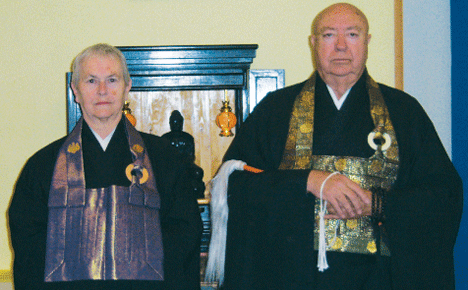
Roshis Fern and Ken Hogaku McGuire--They died two days apart, June 22 and 24, 2012


Ken Hogaku McGuire-roshi died of an apparent heart attack two days after his wife Fern McGuire-roshi died in almost the same manner. They were childhood sweethearts in Kansas and had been married 55 years. They studied together with Matsuoka-roshi, beginning in the 1960s. Ken Roshi, as he was called, was the teacher of my teacher, Harvey Daiho Hilbert. Like a koan it is—the sudden death of two teachers, husband and wife, inseparable. Together they had built and administered the Daibutsuji Zen Temple, first in Las Cruces, then in the mountains above Cloudcroft, NM. This is where I first encountered them. On the Sundays of our sesshins we’d have our final services in their zendo. It was a beautiful and quiet place. A few years ago, they retired and returned to their home in Las Cruces. Ken was a fine carpenter, specializing in ZenFurnishings. Fern was a householder, a mother. Their practice was a tributary of the deep stream of our own practice. And now their human presence is gone. Emptiness, the water disappearing into the earth. Seeds and flowers and fruit and death. So it’s no surprise. We are here. Right now. We vow not to squander our lives.  

On Friday, 29 June, there will be a memorial service for both Ken and Fern on Friday at 10:00 AM at the Getz Funeral Home in Las Cruces, NM. Afterwards the Clear Mind Zen Temple will host another service to honor Fern Roshi and Ken Roshi. Two monks who had practiced with Matsuoka along with the McGuires will be visiting to celebrate their old friend. If anyone in El Paso wants to attend, please contact me at 915-241-3140.

Sit strong. The path is everyday life. Nothing special.

—Bobby Kankin Byrd

Saturday, June 23, 2012

In Memory of Fern McGuire Roshi (1937-2012)


Dear All, 

Yesterday, Friday June 22 2012, I received this message from Ken Hogaku McGuire Roshi announcing the death of his beloved wife of 55 years Fern McGuire Roshi. She died on her birthday.--Bobby Kankin

●


A DEEP GASSHO TO ALL

IT IS WITH MUCH SORROW THAT I REPORT TO ALL THAT REV. FERN ROSHI HAS PASSED ON.

SHE WAS FOUND THIS MORNING OUT IN THE YARD LAYING BEHIND THE TRUCK.  IT IS CONJECTURED THAT SHE HAD A MASSIVE HEART ATTACK AND WENT QUICKLY AND WITH LITTLE PAIN.

THERE WILL BE A "FRIENDS AND FAMILY" GATHERING ON FRIDAY MORNING STARTING AT 10:00 AM AT THE GETZ FUNERAL HOME.  IN KEEPING WITH THE TRADITION FOR MONKS,  THERE WILL BE NO FUNERAL NOR ANY CEREMONIAL CONDUCTED OTHER THAN THE SLOW CHANTING OF THE HEART SUTRA BY MYSELF, HER HUSBAND OF 55 YEARS.

PLEASE-----PASS THIS MESSAGE ALONG TO ANYONE WHO MAY HAVE HAD THE PRIVILEGE OF MEETING THIS EXCEPTIONAL PERSON.

●

My strongest memories of Fern Roshi was as Ino--the way she chanted the Heart Sutra, especially its introduction, and struck the big bell with such attention and passion. Once, at the Dharma Mountain Zendo in the mountains above Cloudcroft, she asked me to serve as Ino. She wanted to just sit for a change. But she was worried about the big bell. She took care to explain how it should be struck. I was honored. Fern was a quiet but stern lady, truly a farm-raised American citizen who understood the unity of all things. Practicing with her was always a special occasion. I was astonished when I heard from a friend that she suffered back and leg pain. I would never have guessed it. She was a role model for me and others. She knew what it was to practice the Dharma, and her very presence was a Teisho of utmost wisdom. 

Below is photograph taken on the day of my Shukke Tokudo Ceremony. Fern and Ken Roshis made the drive down from Las Cruces to be with me and with our Sangha.